

Editor’s Note: Sources citation from the original manuscript (an academic work) has been expunged in this piece for tidiness. This piece is an abridged version and aspects involving national security have also been expunged.
Although Nigeria has diplomatic links with Iran, with ambassadorial presence in both countries, the current relationship between them, unlike the relationship with Saudi Arabia, is far from cordial. Since the 1979 Iranian Revolution, Iran’s foreign policy in particularly the Muslim World has centered on ‘Khomeinism’, defined as “a form of Third World political populism—a radical but pragmatic middle-class movement that strives to enter, rather than reject, the modern age…a militant, sometimes contradictory, political ideology that focuses not on issues of scripture and theology but on the immediate political, social, and economic grievances of workers and the middle class…[Khomeini] has systematically manipulated history to bolster the clergy’s reputation as champions of the downtrodden and as defenders against foreign powers.” Nowhere in the world outside the middle east has Khomeinism had a greater impact than in northern Nigeria despite its distance from Iran.
Iran’s foreign policy is heavily impacted by the self-acclamation of the country as the capital of its sect’s version of the Islamic religion. The country is quick to speak out against democratic governments in support of any religious group agitating for relevance. Similarly, all agitators against western powers, including the Shi’a sect in Nigeria, enjoy their support, often in cash and hardware to engage the state in combat. The Nigerian government’s position is that the sect’s most popular leader in Nigeria, Sheikh El-Zakzaky, committed treasonable crimes against his country and harassed his locality for a sustained period. His followers are induced mainly by financial support from him/the sect and enjoy the sect’s condoning of temporary marriage at an affordable cost as well as apprentice programs and educational scholarships to a teeming youth population. Youths, averse to commitment, either for economic or social reasons, are attracted to the sect because unlike in the Sunni doctrine, the Shi’a doctrine explicitly allows temporary marriage (Mut’a), for say a few days or months or even a year.
The Nigerian government’s inability to make essential services such as schools and hospitals – the sect operate their own schools; and hospitals in some northern states through the ISMA Medical Initiative – readily available to all and sundry has made a vast number of people susceptible to financial inducement to take part in what the top Nigerian diplomat described as nefarious activities and worryingly, adoption of ideological agendas to subvert the government, and destabilize the polity. The sect’s members are encouraged to take part in bold activities to show their disdain for democratically elected authority and advertise themselves as a platform for propagating all grouses against the government. This has caused the sect to attract membership from all professions, religions, and tribes, but enjoys a poor majority.
Sheikh El-Zakzaky, the leader of the sect has no recognized or formal economic venture to which his wealth can be directly linked. Although this lack of formal economic venture is applicable to most other Sunni clerics, Sheikh El-Zakzaky’s case becomes more obvious as most eyes are on him because his religious stand deviates from the longstanding norm; and because he is politically exposed. Some internal economic activities have given members of the IMN a sense of financial stability though – the policy of buying from your kin assures their members of an established share of the market, which gives them confidence to give things on credit, both buyer and seller giving each other financial succor. Other policies are in place to bring members out of poverty, as well as provision of basic needs such as medical care and education exclusively for adherents.
Most of IMN’s activities in Nigeria are financed through its Shuhada Foundation. The sect’s leader inaugurated the foundation as a not-for-profit organization in 1992 with the sole aim of assisting the needy. According to the IMN website which boldly captures the portraits of Sheikh El-Zakzaky, Imam Khomeini and the Iranian Supreme Leader Ayatollah Ali Khamenei, some of the aims and objectives of the foundation include:
1. To provide assistance for orphans (particularly children), prisoners, victims of social upheavals and natural disasters. This assistance includes both “material and spiritual.”
2. To provide education from nursery (Montessori) to the tertiary level to the needy.
They finance these activities through cash and kind donations which they solicit from “individuals, governments and NGO’s.” The sect invests part of these funds in blue chip companies, shares and bonds. These “individuals, governments and NGO’s” cannot be further from Shi’a or Shi’a-leaning individuals, governments and NGO’s. These entities cannot be more typified than by Iran, Hezbollah and other Shi’a or Shi’a-leaning individuals and NGO’s.
The IMN also uses the “donations” they solicit from “individuals, governments and NGO’s” to finance other activities like what they call ISMA Medical Initiative to provide healthcare to sect members by Iranian-trained and IMN-locally trained Nurses, Pharmacist, Doctors, Laboratory Scientists, Bio-Medical Engineers, Community Health Workers, and First-Aiders. The sect also owns and funds two news publications – Almizan (Hausa) and the Pointer Express (English). One of the sects most controversial activities is the operation of the Hurras which they insist are guards, but which the Nigerian government claims are militia and consequently, a Nigerian court granted permission to the Buhari administration to label the IMN a terrorist organization.
With all of these incentives made available in the name of the professed leader of the sect, the Ayatollah of Iran, the adherents of the sect are disenfranchised from the Nigerian state by choice of ideology which pledges loyalty to Iran. While the impact of the group’s activities didn’t affect Nigeria’s perception of Iran for over two decades, the unfortunate incident of December 2015 which led to the capture of the sect’s leader in Zaria has caused Iran to openly and aggressively express their support for the sect and its leader.
Iran invests heavily on educational scholarships for the sect’s adherents all over the globe: there are established educational institutions that host students from all over the world to teach them STEM subjects alongside theological studies. Most students confess that theology is given prominence over the other subjects. Iran also sponsors adherents from other countries to undertake master’s degrees and PhDs in third party countries including the United Kingdom, United States and the EU States. The strategy is clearly to educate adherents into power and civil service of all countries in order to use them as proxy for influencing other government’s policies or sourcing information to be used to further Iran’s causes and ambitions.
In what Nigeria sees as interference in its affairs regarding the activities of the Islamic Movement of Nigeria, Iran had, after the December 2015 Zaria Massacre, written Nigeria. The Iranian solicitor-general and the Iranian parliament had both separately written the Nigerian government; and Iranian foreign ministry had summoned the Nigerian Ambassador twice, all over the detention of Sheikh El-Zakzaky. However, these are standard diplomatic practices worldwide.
Trade and cultural relations are very low considering the potentials of both countries. Iran does not see Nigeria as an equal partner and would always feel entitled to dictate terms of cooperation. Secondly, their interest in the case of the leader of the Islamic Movement of Nigeria, Sheikh El-Zakzaky, supersedes all other bilateral matters, and since they feel superior to Nigeria economically, they feel that not promoting business interactions with Nigeria is a punishment. They do use a plethora of products to send financing for the sect to Nigeria. The goods are sold in Nigeria and the revenues are used there too.
There is no bilateral assistance between the two countries, the only support may be in the form of votes for each other’s candidates in elections into positions within international organizations where both share membership. Their support for the Islamic Movement of Nigeria is all encompassing – they provide ideological direction, strategy, political support against the government of Nigeria and financial support. The sect enjoys use of the state-owned media outlets to spread its agenda within Nigeria and globally, there’s a dedicated Hausa Radio service for projection of Iranian propaganda into Nigeria and Hausa communities across Africa. Iran provides fully funded scholarships for adherents locally, in Iran and in other countries so that they can be accepted into government service without being linked to the sect or ideology.
The Statistics of members of the sect in Nigeria assisted by the Iranian government are very hard to generate due to the fact that the recruitment/selection process of candidates is informal and done without the knowledge/consent of the government of Nigeria since the two governments do not have any educational agreement between them. The sect members in Nigeria collaborate with the Iranian embassy and cultural center to select students and arrange their travel preparations and ship them to Iran to be received by both Nigerian and Iranian representatives of the institution at the airport.
Over 1,000 theological students of the Al Mustapha University are currently registered with the Nigerian Embassy, over 100 self-sponsored medical students currently attend the Tehran University of Medical Sciences, many of them are not members of the sect though.
Among the first set of Nigerians to study in Iran is the apprehended leader of the Islamic Movement of Nigeria, Sheikh Zakzaky in the 1980s, the Nigerian Minister of Education, Adamu Adamu also studied the Persian language in Iran in the 1990s, however, there is no official record that can be referred to for accurate statistics, especially since Nigeria established relations with Iran before the advent of technology used to maintain data.
Iran has lobbied member states of the D8 to situate the D8 University in Iran. The D8 University is situated on an existing campus of an Iranian University. D8 Members, including Nigeria will be forced to recognize degrees issued by the Institution and Iran may use the university to certify its adherents in order to circumvent the traditional bilateral educational agreements.
Nigeria has had a cordial relationship with the Kingdom of Saudi Arabia even before independence in 1960. Since the twelfth century when many political leaders and merchants in present day West Africa accepted Islam and started the Hajj pilgrimage to Mecca and Medina in present day Saudi Arabia, a bond started to build. The pilgrimage by Askia Mohammed of Songhai Empire and Mansa Kankan Musa of Mali Empire was a good example. Northern Nigerian Muslims have studied Islamic jurisprudence, Arabic, and other aspects of the religion at Islamic universities in Arab countries, including Saudi Arabia, since the 1950s. The Saudis have been giving scholarship grants through the International Islamic Relief Organization of Saudi Arabia to hundreds of students annually. Nigerians used to constitute the largest number of foreign students in the University of Medina for example, with a turnover of about 100 students annually. The Saudis must have trained between 15000 and 20000 Nigerians so far, through this assistance. However, these students where hitherto, trained to be Imams, before the Saudi authorities realized that Iran was training hundreds of Nigerians in engineering and medical sciences annually. These Iranian-trained students are also trained in the Shi’a doctrine and they come back home to fit into the economy and public service. Since the training ratio of one Imam to 10 science-based disciplines will better match the Iranian endeavor, the Saudis have now started giving scholarships to Nigerian Sunnis to study medicine, engineering and ICT. They also spend millions of dollars annually in building mosques, drilling boreholes for potable water, catering to the needs of thousands of orphans particularly in the predominantly Muslim northern Nigeria.
Because of the central position of Saudi Arabia in Islam, as the Qiblah – direction all Muslims turn to during prayer –, the relationship between Nigeria and Saudi Arabia has continued to be cordial. In an interview with Sheikh Ahmad Abubakar Gumi (Sheikh Gumi Jr.) – son of Sheikh Abubakar Mahmud Gumi who established the reformist movement, Jama’atu Izalat al Bid’a wa Iqamat al Sunna (simply called Izala) and who studied to doctorate degree level in the University of Medina – he said the only glitch that ever occurred in their relationship was during the first Gulf War in 1990 when Nigeria refused to contribute troops but assisted financially. The anti-American sentiments and consequently pro-Iraqi stance in the north then, which led to a demonstration at a U.S. Consular Office in Kaduna, northern Nigeria by about 5000 youths, must have pushed the military government to stay neutral. However, this neutrality was misinterpreted to mean support for the U.S. by the military government.
Both Iran and Saudi Arabia exert influence in Nigeria through religious education, scholarships for engineering and mathematics students, and other means. In the case of Saudi Arabia, foreign development assistance directly to the government is added, whereas oIran almost solely extends its influence through the IMN. Since the Nigerian political elite who control the major state institutions are Sunni Muslims, there is a great deal of ideological/sectarian affinity between the political elite in Abuja and Riyadh.
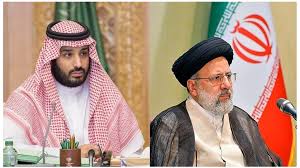
Saudi Arabia, the birthplace of Islam and a monarchy, regards itself as the leader of the Islamic world. The Islamic Revolution of 1979 in Iran which overthrew a monarchy and established a revolutionary theocratic state with an opposing Islamic doctrine to that in the Saudi Arabian monarchy must have upset the political elite in Riyadh, who feared that similar revolutionary model may play out in its territory to oust the monarchy, hence the geopolitical rivalry in the Middle East where the political blocs in the region look towards either Saudi Arabia or Iran. This rivalry is similarly being played out in Africa, particularly in East and West Africa, but most especially in northern Nigeria where the indigenous Shi’a population has grown rapidly in number and influence since 1979
Northern Nigeria has had feudalist history and tendencies since the pre-Islamic, pre-colonial, and even pre-Danfodio Jihad eras. The commoners had developed the spirit of resistance from the highhandedness of the monarchies which were so powerful. It was due to their power and overbearance over their subjects that the British colonialist ruled the region indirectly through the monarchies led by Emirs, as opposed to the southern parts of the country. This resistance by the commoners against the feudal emirs and elite explains the popularity of Marxist professors in the department of political science of northern Nigeria’s premier university, the Ahmadu Bello Universi7ty. Undergraduate children of commoners had seen how the feudal elite had suppressed their parents hence they found revolutionary Marxist ideas attractive for a revolutionary overthrow of these monarchies and changing the status quo. This period also coincided with the Iranian Revolution and the emergence of El-Zakzaky as an arrowhead of “Khomeinism” in northern Nigeria. These undergraduates, mostly northern Nigerian Muslims, now saw the Iranian Revolution as another template for overthrowing the “feudal” elite and effecting the desired revolutionary change. El-Zakzaky, therefore, received a deluge of overzealous converts because he came at the “right” time.
Iran seeks to export “Khomeinism” to other parts of the world with majority, or appreciable, Muslim population, including Nigeria where the IMN serves as its vehicle. Given Iran’s regional competition with Saudi Arabia, the elite in Riyadh feel threatened whenever Iran appears in any region of Saudi influence like northern Nigeria. The IMN is therefore more political than religious. They serve as one of the vehicles for extending Iranian influence around the world and only want to replicate the Iranian revolutionary model in Nigeria, or at least in northern Nigeria, after probably the partitioning of the mostly Christian South from the Nigerian union. Most of IMN clashes, as we have noted, have been between them and the state. There have been clashes with Sunni Muslim citizens of course, but they are not in close comparison in terms of severity to those with the agents of the state. There is a probability that Iran is clandestinely trying to arm IMN which has some semblance with Hezbollah (minus the arms). This could have informed the much-condemned military action against the IMN in December 2015 by the Nigerian government which destroyed its spiritual headquarters, killed hundreds of its members and captured their leader, Sheikh El-Zakzaky. In the last decade, successive Nigerian governments have unsuccessfully fought the Boko Haram terrorist group which professes Sunnism; so, an armed IMN which is more organized, adds to the more probability of further destabilizing the country and even leading to its partitioning.
The rivalry between Saudi Arabia and Iran in Nigeria, therefore, does not appear to be ideological as par Shi’ism versus Sunnism, but an elitist geopolitical contest laced with regime survival on the side of the Nigerian and Saudi governments. The Saudi monarchy fears the fate of the pre-Khomeini monarchy in Iran, while the Nigerian government which happens to be mostly controlled by the Sunni elite, are afraid of being overthrown by the “commoners” in a revolution by either the Shi’a-led IMN or Sunni-led Boko Haram.
Culled (and abridged) from “Understanding the Saudi-Iran Rivalry in Nigeria,” thesis by Mustapha S. Shehu and supervised by Prof. Jeffrey W. Taliaferro, for the award of Master of Arts in International Relations by the Fletcher School of Law and Diplomacy, Tufts University, Medford, MA, USA.